Track our Journey!

Wednesday, 27 February 2013

Escape to Coroico!


After 58 days in La Paz, it’s finally time to leave! We cannot afford to wait around for the Irish and the Bolivian postal services to get their act together and deliver my new ATM card, so we’re jumping ship and going on our merry way again.
But the last few weeks weren’t without any adventure. Of course there was the usual Wild Rover madness, but Kev and I also managed to disappear to Coroico for a few days, to make ourselves feel like we weren’t completely wasting our time here. Coroico is the end-point of the hair-raising Death Road bike ride and is a world away from the chilly altiplano climate of La Paz. Only 2.5 – 3 hours away, it’s a small town perched within a tropical forest-covered valley called The Yungas. Most importantly it had the one thing we’ve yearned for most since our time here: HEAT!! It has a warm, spring-like climate all year round and it’s at much lower altitude that the city. Like little excited school kids going on a school tour, we set of on our mini vacation, being transported to Coroico in a people carrier, wedged between a grumpy teenager and a traditionally-clad woman with a baby in her blanket. The 3-hour drive there was spectacular in itself; along the main road which forms the first part of the Death Road cycle. The road winds initially through sparse high-altitude mountains which look remarkably like the tree-less expanse of Connemara. Next, as we descended we were driving past huge black rocky Andean peaks, dusted with a constant layer of snow – simply breath-taking. Funnily enough, as the journey went on and as we reached lower altitude, the heat gradually hit us; windows were opened and jumpers came off. The scenery was changing immensely too; the mountains remained, yet instead of snow, there was a thick blanket of tropical vegetation including banana trees, coffee plants and palm trees.  The bus left us in the small town square and we got a taxi up the steep hill to our abode for the few days, Sol Y Luna.
Sol Y Luna markets itself on being an “Eco lodge”, providing an Earth-friendly place to stay with hostel rooms, camping facilities and private cabins or cottages. Kev and I went for a little cottage called Nectar, with adobe walls, a small kitchenette and a balcony with a beautiful view. It looked very much like an old Irish shebeen if you will and we absolutely fell in love with it. Our balcony provided us with an uninterrupted vista of tropical forest in the foreground fading into mountain peaks in the distance, with wispy, misty clouds rolling in over the tops and up from the bottom of the valley floor below. We sat in our deckchairs on the balcony for hours, just watching nature perform in front of us, making it seem like we were sitting in a zoo enclosure. Everywhere we looked there were birds with yellow tails twittering away, eagles soaring and stalking their prey, hummingbirds zipping around beautiful bright pink hibiscus flowers and hundreds of butterflies flitting around, displaying their vivid colours with every flap of their wings. But because God has a mischievous streak, he also tainted this wonderful scene with the scourge that is Sand Flies. Sand fly bites are equally as unnoticeable until you notice a little spot of blood on your leg, and 20 minutes later it’s a red lump, some of which are just downright painful. No amount of insect repellent could deter them though and after a while it looked like I had a bad case of chicken pox. Thankfully though, they don’t spread disease, they’re just irritating enough by their mere presence. Our little cabin also had its own shower and toilet, both of which were located outside in another little hut. Luckily there were no spiders to interfere with my “connection with nature” and there was something very satisfying about having a hot shower while watching the sun disappear behind the mountains.
Coroico Valley
our little cabin


Beautiful flora and fauna

We spent the days lounging around the small, very cold pool and taking in the rays and our dose of Vitamin D. Coroico town was a 15 minute walk downhill, past some snappy dogs, but there was a beautiful viewpoint on the way, giving a panoramic view of the valley and the river meandering its way through the green peaks. Eagles could be spotted gliding their way over the valley as they searched for their next meal. In the town, we stocked up on fresh veg, fruit and pasta at the open market and a lady with 3 freshly-dead chickens cut off the entire breastplate of one poor thing for our dinner; 2 chicken breasts for €1, very cheap living and she threw in a lung for free. It felt great to finally cook for ourselves again and get away from the hamburgers and curry chips we were getting too used to in the Wild Rover. We relaxed on our deckchairs, admiring the sunset with beers in hand, swatting sand flies away and chatting about nothing in particular. We were glad to have ourselves to ourselves again, enjoying the peace, quiet and sounds of birds instead of the same soundtrack in the pub every night. Our neighbour from the nearby cabin invited us over for some beers and we sat outside their cabin in hammocks with him and his Argentinian girlfriend, practiced our dodgy Spanish as the local church bells signalled the arrival of 8pm. Their view was also breath-taking, a wide, open vista of the twinkling town lights below, with the bright moon casting an eerie glow on the tops of the trees. On our last night, we also met a German couple who we escorted from the town to the hostel and to repay the favour, they were so nice to cook for us. So again we enjoyed good company, some questionable beers, and some delicious food while discussing British 70s comedies, global warming and questioning how much of written history is actually accurate. We stumbled back to our cabin in the rain and snuggled in under our mosquito net-covered bed and drifted off to sleep to the sounds of heavy rain pounding off the corrugated iron roof.
View from the balcony
When the dreaded time came to leave, we decided we want a cottage in the country when we return to Ireland and I’m going to take up gardening. The drive home was an experience to say the least. Our driver insisted on cutting every corner, narrowly avoiding head-on collisions and taking bends with such speed that the tyres screeched. A few driving lessons wouldn’t go astray in this country! He could definitely give The Stig a run for his money. The scenery on the way back was noticeably different; the heavy rain obviously hit the altiplano too and what was a gentle frosting of snow the days previously was now a full-blown ski slope. The almost vertical mountains were striped with fresh waterfalls, varying in size from thin, wispy streams of water to impressive roaring torrents of water that threatened to spill over on to the road. We came across a fresh landslide, with a mini JCB just starting to clear the debris. We made it back to La Paz in record time, thanks to our Formula One driver and reluctantly made our way back to the hostel.
It was so refreshing to escape again for a bit of seclusion for a few days and enjoy being in each other’s company, without the stress of the bar. We feel ready to hit the road again and we have decided to head away to Sucre and continue on the road towards Chile. And it really couldn’t come sooner!!

Where we stayed: Hostel Sol Y Luna http://www.solyluna-bolivia.com/
  
How much?: 260 Bs (€26) per night for a private cabin with private bathroom and kitchen

Thursday, 7 February 2013

Pampas Tour in the Bolivian Amazon


Right so, we’ve been cajoled into working for one more week in the Wild Rover, as they’re short on staff…or maybe it’s because they love us so much, who knows?! PLUS, someone managed to clone my ATM card, so I’ve to stay put until Ulster Bank manage to send me on my new Debit Card, so just when we thought we had cut the umbilical cord connecting us to this place, we’re back in the womb again! Hello Hotel California!

We did manage to escape for a few days for a wonderful trip to the Amazon Basin however. Just before we finished up work we booked ourselves a 3-day Pampas Tour with Hoatzin tours, which we booked for  the knockdown price of 1200Bs (€120) each, including return flights to Rurrenabaque which was our starting point of the tour. 1200Bs was a steal considering the standard price is 1800Bs and I paid almost double that for the 3-day tour when I was in Brazil this time last year. So we packed up our stuff, said our hasta luegos (knowing we’d be back in a few days’ time) and paid off our tabs for the last month.  Wow this came as a shock, damn that Dice Game, 14 Baby Guinnesses??? In true “Murphy’s Law”, that day there were protests on the streets of La Paz, so getting to the airport was more like as episode of “Challenge Aneka”, with some Colin McRae- wannabe taxi driver bringing us through the narrowest streets to avoid the road blockages. We arrived at La Paz Airport, a glorified barn and checked ourselves onto our flight with Amazonas Airlines. “I’ll give you seats 3A and 3C” said the air stewardess, “lovely seats beside the window”. We discovered when we climbed onto the tiniest plane in the world that all the seats are window seats, separated by a miniature aisle, wide enough maybe for an 8 year-old to walk through. In noted, once I folded myself into the cramped seat that the plane was a Fairchild aircraft. “Wonderful” I thought “a smaller version of the plane that crashed into the Andes into the Andes in the movie Alive”. As the cockpit was so miniscule, there was no door separating us from the pilots so we could see everything, and hear everything, including the concerning rapid beeping! There were into total about 10 people on the flight. The propellers started up and before long we were hurtling down the runway and thrust into the air, hanging there it seemed by the grace of God and the warm air current. As scared as I was, this was thrilling; the smallest plane I’d ever been on and we were coasting over the Alti-Plano of La Paz, the huge snow-covered peaks of the Andes and 30 minutes later we were gaping out the tiny window as the majestic mountainous jungle of Rurrenabaque and the Amazon. It spanned as far as the eye can see, like something from Jurassic Park, there were vertical rock faces covered with thick foliage, flanked by row after row of tall palm trees. We landed on an air strip short and narrow enough to be considered a country lane, complete with grass growing up the middle and we taxied to the airport with was a corrugated iron-roofed shed. Getting off the aircraft, the first obvious thing that hit us was the immense heat and the stifling humidity. Coming from the frigid evenings of La Paz, baking in 35°C+ heat and 98% humidity at 6.30pm was a shock to the system certainly. Amazingly, we had switched climates dramatically in 40 minutes; at least the alternative 22 hour bus journey may have allowed for a more gradual acclimatisation! We hopped into a taxi and made the short spin into the town centre, along a road which on one side had those aforementioned majestic jungle mountains and on the other side had small straw-covered huts and wild chickens running all over the place. “Now THIS is South America” we thought; unimaginable poverty, yet the most beautiful, smiley little kids running after the taxi and waving at the Gringos as we drove by. Animals everywhere and gorgeous brightly-painted huts; this is the stuff I’ve seen on TV! We picked a hostel at random, one called Los Tucanes, which cost us 100BS per night but was one of the most unpleasant hostels of our trip. There were huge holes in the curtains which made me question their presence in the first place, a fan which was so slow it made no difference to the damp warm air of the room and THE most uncomfortable bed ever! But for one night we just sucked it up and dealt with it.
                The next morning we arrived at our tour company at 8.30am and of course, in true South American-style, we didn’t get going till 9.30am. Our rickety-looking jeep picked us up carrying Flo, from Holland, Chan from Korea, Pierre from Italy and Franco and Chino from Chile. In the cramped jeep we quickly formed a friendly rapport during the 3 hour drive to Santa Rosa, from where we bailed onto a long, canoe-style boat and where we met our guide Alex. We were warned about the presence of many mosquitos on the river, so we promptly covered up. Even still we were getting quickly abused by mosquitos! Apparently linen pants aren’t enough to deter the massive mosquitos of Rurrenabaque! The hour or hour and a half journey down the river towards our lodge was amazing; every 5 minutes or so we stopped to observe some animal or other. We saw alligators swimming by the banks, Paradise Birds with their bright blue faces, Cormorants, Eagles, Egrets, Howler Monkeys watching us from the tall branches and cute little Squirrel Monkeys. The encounter with the Squirrel Monkeys was hilarious; Alex produced a banana and within seconds they all jumped onto the boat and climbed all over us too in the mad dash to feed on the banana. Our close proximity to them allowed for some great photos and we were assured that they’re not aggressive and will not attack you. Good thing really, cos I had 3 crawling on my head. When we finally arrived at our basic lodge, we surveyed the accommodation (beds with large mosquito nets on them, and some toilets and showers very much open to the elements!) and dumped our bags. We swallowed down the cold juice we were given with gusto, MAN we were sweating so much, it was impossible to keep your face dry! That evening, we were brought to a common area on the river for all the tourists the congregate, play football (yes, EVERYWHERE you go in South America will have a football pitch, even in the Amazon!) or just chill out and have a cold beer. We were treated to a beautiful sunset before taking our mosquito-bitten asses back to the lodge, where a surprisingly sumptuous slap-up meal was waiting. When darkness fell, we again went out on our little canoe and with the help of some torches, searched the banks and the water for the tell-tale red eyes of Cayman alligators. Elusive as they were, we managed to spot a few small ones before retiring to the lodge for the night.

                The next morning we were exciting about the possibility of seeing an anaconda. We were brought to an area of open grassland and swampland, where we searched with the other tour groups for the giant snake. Our guide was telling us scary stories of the largest snake he has seen in all his time in the jungle; a 10m monster with a body as large as a big dinner plate. Not knowing whether or not he was taking advantage of my gullible nature, it made me a little more wary when walking through the waist-high grasses, although we were told that a snake that big was very rare and that we should expect to see something no bigger than 2-3m. The grasses soon turned into knee-deep swampland where the attention was focused as this, we were told is where they all like to hang out. One tour group later told us that they saw the head of one (about the size of a mango) sticking out of the water but when the guide tried to catch him it slithered away to safety. Whose safety I’m not sure! We unfortunately saw nothing however, and at this stage it was 10.30am and absolutely baking hot. The heat was reaching 37°C and we all appeared to have come straight out of the shower we were sweating so much, I had never experienced that humidity before; it was like walking around in a sauna, absolutely horrible!! Thankfully we were brought back to our lodges soon after, less disappointed at the lack of anacondas and more grateful for the breeze that was blowing in our faces as the boat raced down the river.

Next we were brought to a wide area of the river where Pink Dolphins love to swim in abundance. Were you brave enough to get into the murky brown, smelly water you could go swimming with the dolphins, but considering the stories one girl told me of them biting her foot, I was less than keen to get in! Not to mention the fact that a few hundred yards away there were plenty of alligators, including Pedro, the alligator that liked to lurk around our lodge – there was no way I was stripping off to get in there! That being said though, some brave souls did get in and the dolphins became curious. Not on the same level as Fungi now mind, but we got some good photos nonetheless. That night we took it easy, grateful that the sun had gone down and given us a slightly cooler night. We played pool and chilled out on the deckchairs by the river, listening to the sounds of bats, night insects and birds while watching the beautiful starry night sky and admiring the dramatic electrical storm in the distance.

                The next morning, our last, we were brought to the more sheltered parts of the river in the hope of catching piranhas. Unlucky for us though, the f*ckers decided not to show up and the fishing trip was rapidly abandoned and we were brought back to the Dolphins for some more attempts at photographing them at play. After lunch it was time to leave, say goodbye to our lodge, Pedro the alligator and make our way back to Santa Rosa again, where our chariot would bring us back to Rurrenabaque.


                The three days were one of the most amazing 3 days; we saw so many animals up close and it was refreshing to get out of the suffocating altitude of La Paz for a few days. One thing I won’t miss however is the presence of large frogs in the toilets and the showers, making me uneasy as it meant there were more than likely lots of snakes about! Now that we’re back in the Wild Rover, I can appreciate the cushioned toilet seats, toilet paper and clean, hot showers! It was a fascinating experience and on return to Rurrenabaque that evening, we were treated to the spectacle of anniversary celebrations which resembled a miniature Carnival! That evening we all decided to stay in the same hostel, a really cosy hostel called El Curichal, which actually had working fans!! It was a great ending to a wonderful 3 days but I have brought back with me, the worst case of ass mosquito bits ever!

Where we stayed: Los Tucanes de Rurrenbaque  http://www.hostelbookers.com/hostels/bolivia/rurrenabaque/62680/
How much: 100Bs double room, private bathroom

How much: 90Bs double room, private bathroom

How much was the Tour?: 1216Bs with Hoatzin tours and Amazonas Airlines

Sunday, 3 February 2013

Tequila and Tattoos - A Month in the Wild Rover


So, 2 weeks of working in the Wild Rover Hostel in La Paz, Bolivia turned into 3.5 weeks, due to the fact that we would receive an additional 20% off food and drink and cos we were having such a great time, meeting some really lovely, crazy, mental, fun people and going on the piss for nearly an entire month! Working here has been one of the most random yet rewarding experiences of our trip to South America so far. It was an unexpected stop-off in one of the more random cities of the trip, certainly not one of the places I expected to spend almost a month of my life!

I remember seeing the city for the first time as we arrived here the day before New Year’s eve and thinking “Holy crap, let’s get back to Cusco, NOW!!”; the poverty and the general hodge-podgeness of the place made me immediately adamant that we would stay no longer than 4 or 5 days. Almost one month later, I nearly have to be dragged kicking and screaming from the place I have called home, with my new-found family of Bolivians, Irish, Aussies, Kiwis and Brits. I have grown used to working all night and seeing pretty much no daylight for 3 days straight, going from the bar to the staff dorm room and back again, repeatedly, venturing out of the hostel occasionally to eat in other restaurants and to head to one of the many night clubs once the bar had closed.

The hostel here was most definitely a “party” hostel; no night was a quiet night and Diego, our Bolivian Events Manager who is developing an Irish accent made a huge effort in organising a different themed night every night. We had parties such as Tequila Night, UV night, BBQ night, and probably the best one so far was the massive Oz-themed piss up for Australia Day on the 26th January. There was an all-day BBQ, lots of Aussie paraphernalia, drinks specials all day, the infamous Triple J Hottest 100 Countdown and a general good-humoured jolly atmosphere between the largely Aussie – Irish contingency.  As bar staff, and ultimately volunteers, we were encouraged to chat to and have a few drinks with our customers, making them feel welcome and of course, encouraging them to drink more! This resulted however in us regularly getting AS drunk as the customers, if not worse my case – note to self that drinking too much tequilas on Tequila Night will result in me having to be escorted to my bed! But hey, at least we boosted the sales of Tequila! There is the nightly ritual of dancing on the bar, some say it turned into a scene from Coyote Ugly, with the bar maids regularly getting up to dance to Gangham Style or All the Single Ladies, and pouring free shots straight into the mouths of those beside the bar! Luckily nobody fell off the bar, which, considering the amounts of alcohol consumed was a miracle! And of course, I got myself a small tattoo, to top off the craziness levels, but it’s now as much a part of me as my underlying ginger-gene….

On our days off or even just our mornings off (if we got up before 3pm!), we ventured off into the city to explore. The consistently drunk Diego organised tours for the hostel guests (and us!). We were brought to weird and wonderful places such as Valle de la Luna (Moon Valley) and the jam-packed market in the city’s Parque Central for the Alasitas festival:

Valle de la Luna was an unusual, lunar-like landscape just outside the city centre. Being in a valley, the weather was worlds apart from the bustling streets of La Paz. While it was pissing rain near the hostel, the sun was beating off the clay and rock formations of the valley. It reminded me of pictures I’ve seen of other canyon / desert landscapes such as Arizona or such places. We had a wee walk around, took some obligatory photos and made our way back to “normality” by local chicken bus.

The Alasitas Festival of Bolivia began on the 24th January. Traditionally, it is an annual festival where locals converge on the busy market to buy miniature trinkets of items they most desire, in the hope that they will be blessed with genuine, real-life versions of those possessions within the year. You can buy miniatures of literally everything, from cars and houses to college diplomas, groceries and computers. If you desire a girlfriend or boyfriend, you can buy a Barbie or Ken doll to represent them, or if it’s a husband or wife you’re after, you can buy a miniature hen or rooster! The trinkets are then blessed by a “witch”, kind of like an ancient Celtic Druid; they pray and bless the trinkets with Holy Water and use flower petals and incense to complete the ceremony. When your trinkets have been blessed, the idea is to arrange them around a statue of the “god” called Kkekko, put a lit cigarette in his mouth and offer him and Pacha Mama (Mother Earth) some alcohol and pray that your desires come true.

I will really, really miss this place. I’ll miss the staff dorm room, the great friends we made and the great laughs we had, trying to keep quiet when we stumbled in at 5am, trying not to wake the others up, giggling like schoolgirls at Diego’s train-like snoring and having fits of laughter at Myles looking for his locker key under his bed, pissed as a fart and muttering “what the f*ck is going on?!”. An end of an era, but we’re ready to get going on the road again. Next stop is a few days in the Pampas (grass wetlands) of the Bolivian Amazon before returning here again for a few days! Will we ever make it out of here???

Alasitas Festival

Aussie Day


Tuesday, 8 January 2013

La Paz and the Death Road!


The border crossing into Bolivia, for us went without much trouble, just a bit of hassle with trying to figure out where to go and in what order, nobody tells you where to go, so we just followed the crowd! We were introduced to Bolivian buses however, and Bolivian toilets, which, if the trend continues, are likely to give us Hepatitis.

However, we arrived in La Paz at around 5pm on the 30th December. The ride in was a bit, well, interesting. The road takes you through the outskirts and surrounding Barrios of La Paz which are dirty, grimey and really feckin’ poor. So I assumed of course that all of La Paz was going to be like this and immediately wanted to turn around and head back to Cusco. But all of a sudden, the motorway opened up to reveal spectacular mountains in the distance and La Paz, sitting comfortably down in the mountain valley and it was a real gasp-inducing sight! We checked into the Wild Rover, which was already buzzing with people in prep for the New Year’s celebrations. New Year ’s Eve was set to be a black and white masquerade ball, so Kev and I combined sightseeing in La Paz with searching for tat to wear at the party.  The party itself turned into a crazy one, with pretty much all of the acquaintances of the last 3 months all showing up at once at the bar so we had a major catch up and a subsequent piss up! So, as is predictable enough, we had a great night and the following few days were spent alternating between taking “the Cure” and nursing our sore heads.
Our main piece of blog-worthy news over the past few days is our mountain-biking adventure down the notorious “Death Road”. A good few of us from the hostel signed up to do the trip with a company called “Altitude”, at a slightly bargained-down price of 450Bs (about €50).With my fear of heights slightly quashed, I was still only feeling 60% brave, 40% violently ill. I had heard so many horror stories that it was enough to make me an insomniac for the night and I was awake long enough to count all the church bells nearby notifying the world of the approach of 6am, the dreaded wake up time.

We were all bundled into a fairly old and unstable-looking Hiace van for the 30 minute drive to our starting point, yet again at altitude. Is there anywhere in this continent NOT at altitude?! We were decked out in our protective gear and jackets, grabbed our bikes and off we set down the first part of our journey, a 24km cycle down your average asphalt road, through some really great scenery. And damn it was cold! I assume this part of the cycle was to allow you to get a feel for your bike, test the brakes and the gears etc. before the daunting Death Road began. We had some breakfast at an eatery at the side of the road and then, after visiting the bleak toilets, hopped into the van again, where we would be driven uphill to the start of the Death Road cycle. Greeting you at the start of the road is a giant Caution sign, which contained too much text for me to read from a moving vehicle, but I’m pretty sure it was saying “turn back now, you crazy, crazy people”.

Our group before we set off on the Death Road
The Death Road is now relatively unused by cars, trucks, vans and buses now since a newer, safer road was constructed a few years ago. This road, winding its way through the mountainside is only 3m wide in some places, with a dizzying, stomach churning 1000m drop to your left. And, when you’re a cyclist, you’re obliged to keep to the left at all times and in the case of meeting a vehicle, the vehicle is obliged to keep to the mountainside, therefore, leaving you, on a bike, standing on the edge of a massive drop as the car passes. If you managed to find yourself teetering towards the edge, a fall would lead to certain death; the drop is so sheer that there isn’t much chance of you hitting a gentle undulating slope where you would eventually roll to a stop! All this considered, and with copious amounts of Holy Water later, I was rearing to go. The gravel and sizeable rocks on the road, combined with little channels cut into the road by rain and waterfalls meant that the cycle was hair-raising at the best of times and it was difficult to build up an great speed without risking your life. I found myself, not shitting myself like I had imagined, but actually becoming so exhilarated by the ride and when you had the opportunity to take your eyes off the road for a second, there was some amazing, dramatic scenery to be had, especially once we descended below cloud cover. Our guides stopped us at several locations on the road, the most dramatic and treacherous parts of the road, for photo ops.
The entire road is about 40km and by the time we had mercifully reached the end; my hands were calloused and bruised from pulling so tightly on the brakes! We were hot, sweaty and our hearts were thumping, but we had the best bike journey of the trip. I am so thankful that I decided not to listen to the scare-mongering and do the trip, yet I am equally delighted never to have to do it again. It’s one thing I can tick off the list of things to do before I die. 


a popular photo spot!


many crosses on the route marking the spots where people died


Where we stayed: The Wild Rover, La Paz 
How much: 150Bs (about €15) per room per night, double room, shared bathroom

Saturday, 5 January 2013

Christmas in Cusco and Lake Titicaca!


Christmas, it’s fair to say, was a bit of a write-off, with the entire few days pretty much spent holed-up in the Wild Rover hostel, and catching up on the partying we missed out on over the previous few weeks. The Wild Rover, is, as the name suggests, and Irish-run hostel and is very, well, wild. I couldn’t as much attempt to keep up to date with the blog before someone shouted “Happy Hour!” and a Jagerbomb was thrust into my hand. We were received by the owners Colm and Liam with typical Irish hospitality and we were promised a whale of a time, which would include a Christmas dinner and pretty much party after party. We had heard rumours and friends’ reports of the legendary parties, so this was gonna be our bit of tacky “Oirishness” over the Christmas hols; hell, if we didn’t have a piss up, it’d make us even more homesick!
Our room was a little like a brothel / dungeon with its lack of outside windows and dark red walls. But for the amount of time we planned to stay outside the bar, this didn’t really matter to us. We, party we sure did, 4 days on the trot of White Russians, Mojitos, Rum and Cokes, combined with cheesy Christmas music and random banter with strangers, who would later become good friends. Of course, we met many an Irish person but we had great laughs with some Kiwis, some Yanks and Canadians, as well as bumping into Hannah and Ellen again, from Britain.


Market ladies

Christmas Eve markets in Cusco

On the 4th day, we were broken, shadows of our former selves and suffering severe cases of beer blues. We booked ourselves a night bus to Puno, right on Lake Titicaca, our last stop in Peru before crossing the Bolivian border in time for New Years, where it was set to be another Irish piss up in the Wild Rover in La Paz.

Puno is, well, a shit hole, but people generally just stop off here in order to see the Floating Islands of Lake Titicaca. We did just that, booking a 2 day, 1 night tour with our hostel, the Walk On Inn. It cost us 90 Soles, which was almost half of what the tour company in Cusco were quoting us. We arrived at around 5am in Puno, with enough time to leave our bags at the hostel, pack a small overnight bag and grab some breakfast before we were picked up by our tour minibus to the lake at 8am. Here we were shuttled on to a small boat, with an engine the size of a pea, which would, very slowly take us across to the Floating Islands of Uros. It took about an hour of sailing to get to the islands, set among a vast amount of reeds. We were immediately struck by how Disneyland-ish it looked, very much geared towards tourism, as that’s their only way of making money. There were brightly-coloured souvenirs to be bought and large, elaborate reed boats, reminding me of some kind of organic Royal Barge, which could take you around the island for a small fee, if you fancied something more manual powered than our diesel boat. It all looked like a kid’s playground, and we stopped off at one island and disembarked, to have a wander around and to learn more about the islands. There were 4 families living here in small reed and wooden huts. Our guide gave us the low-down on how the islands are made, how they build their huts and how the inhabitants can even pull the islands together and anchor them in the event of a wedding or something similar, in which many people would be congregated together. I, an eternal skeptic, wasn’t sure how much of it I was believing, and whether it was all nonsense or not. It seems like it would be very hard to live on such a tiny island, when each of them can sustain only a small amount of vegetation and food.  The only meat source scuttling around too are the guinea pigs, who even have their own cute little reed huts. As we sailed away, I could quite clearly see the reeds growing from the lake-bed below, so im not sure as to how deep the water actually is in that area of the lake. Hhhhmmmm, I don’t know!
Local Floating Island residents

Disneyland!


Floating Islands
From here, our next stop was Amantani island where we were to spend the night with a host family. When we arrived after an arduous 3 hour boat ride, we were introduced to Gladys, our very miniature host for the night, in whose house we would sleep and eat. We joined forces with a very friendly Brazilian couple and we were shown to our sleeping quarters. The bed had a straw mattress, but all in all, It was less basic than our accomdations in the Colca Canyon! Lunch and dinner were very basic indeed, but you could tell that these people had nothing, so for tjem, this was probably the best thing they could dish up. The kitchen was itself, like something from National Geographic, with its clay walls, one pot on an open fire and a mat for people to sit on. We humbly ate our meal of maize and squeaky cheese, knowing that they’d sacrificed the best rooms of the house for us. That night, a “fiesta” was organised with the locals, where we were once again dressed up in local clobber and attempted to dance with as much grace as we could muster. To be honest, we found it all a bit staged and we were more interested in the massive thunderstorm outside which was lighting up the sky with bots of purple and pink lightening. We left about an hour after we arrived, just in time to tuck ourselves into bed before the rain and hail started, and we eventually dosed off to the sound of rumbling thunder.

Awesome lightening storm!
The homestay's kitchen
The next morning, after our pancake breakfast, we said farewell to Gladys and her daughter and left for Isla Taquile, an hour away and just as picturesque. We walked around the island, about 2km, and had a nosey at some of the local knitted handicrafts. There was a lunch organised for us on a fabulous hilly location overlooking the vast sparkling blue lake. With the quaint little laneways, small brick and clay huts, tall trees and sweeping views, it reminded me very much of Sicily or what I’d imagine Tuscany would be like. We walked down the hill towards our awaiting boat on the banks of the lake and commenced the 3 hour boat ride home to Puno.

our lunch venue!

Taquile island

After the 2 days, I cannot help but think that the tour is a desperate attempt to get people to the islands and thus increase monetary income for the inhabitants. As beautiful and picturesque the islands are, there’s very little of interest to see apart from the scenery, so maybe a 1 day tour taking in all the islands would have been sufficient. I am glad I saw them and the weather was very much on our side during the trip which added to the enjoyment, but I think it’s a case of “OK, been there, done that, now let’s move on”. So we booked ourselves our bus to La Paz, which would include, what we heard, would be an interesting border crossing! 

 Where we stayed in Cusco: The Wild Rover http://www.wildroverhostels.com/
How much?: 70 Soles per double room per night, private bathroom

Where we stayed in Puno: The Walk On Inn http://www.walkoninn.com/
How much?: 60 Soles

Friday, 4 January 2013

The Colca Canyon (or as we called it, the Coca Cola Canyon)

Well, the world didn't end on the 21st December as the Mayan prophecy led us to believe and a good thing at that, or we wouldn't have gotten the change to enjoy our 3-day Colca Canyon trek!

Arequipa, in Peru it seems in mainly a stopover city for those wanting to trek around the nearby Colca Canyon and to the oasis at its base. Despite being the second biggest city in Peru, there seems to be little else to see within the city boundaries except for the usual pretty main-square-with-churches feature that we've become used to. Having heard about the Colca Canyon, being the 2nd deepest in the world (it's neighbouring canyon being the biggest!) and boasting a tranquil main-made oasis at the bottom, we were keen to exlpore. Deciding to go with a tour group rather than doing the trek independently (more for convenience and the bonus of company of other travellers rather than the necessity of a guide), we booked the 3-day 2 night trek with a company called Peru-Schweiz. It cost us 140 soles all inclusive and as we had absolutely no organisation to do, we gladly paid our fare. yet again, another early start was required, this time our bus was due to collect us at 3am - not for the sleep-lover in anyone. So, like  7-year olds, we went to bed straight after dinner and tucked ourselves in for the night.

Almost slapping ourselves away the next morning, we were collected, late as usual and thus began our epic 6-hour drive towards the small town of Cabanaconde, from where we would start our trek. Thankfully we were due a breakfast stop in Chivay, 3 hours into the journey, where copious quantities of coffeee were consumed. We made our usual ice-breaking chit chat with our fellow travellers and post-breakfast, we continued on the bus towards Cabanaconde. We stopped at a view point called Cruz del Condor, where any hopes of seeing a condor swoop over the canyon were doused by the dense morning mist. We eventually began the trek, all downhill at around 9.30am, the early morning sun casting aside the low-lying mist in the canyon and warming our faces as we walked. Our guide Luis outlined the flora and fauna we would most likely find on our trek, which was slippy sometimes due to the gravel path but the lack of any uphill section alleviated any ill-feeling we had about the trek due to our early start. We took our time and enjoyed the impressive views as the sun gradually spread its cover over the canyon walls and down towards the river below. About 2 hours later we were at the bottom, and crossed another rickety bridge to bring us across to the other side to a small town called San Juan de Chucco for lunch. After lunch there was an alarmingly steep uphill 45-minute walk to where we would spend the first night at the early hour of 3.30pm. Our accomodation that night was a homestay, in the farmhouse of the guide's uncle. Kev and I laughed in disbelief at the sight of our "habitacion" for the night; once probably a cowshed, it had no floor, just earth yet a very comfortable and warm bed. Dinner was at approximately 7pm and we literally went straight to bed afterwards, for a marathon sleep of 12 hours, it was well-needed.

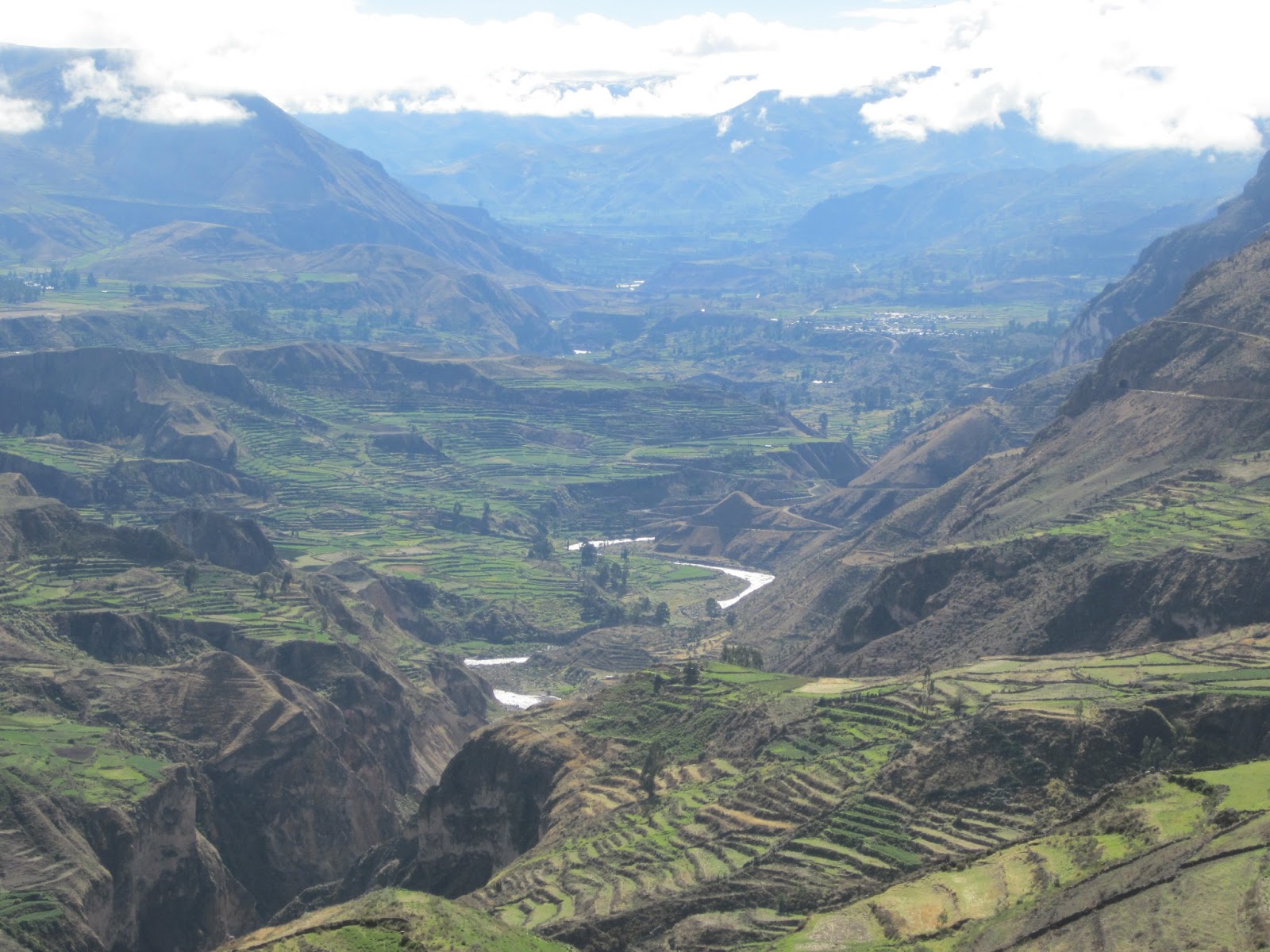
The next morning we had only a short hike downhill to the splendor of the oasis. Man made, it lies on a meander of the river, boasting several swimming pools, bamboo hut style bungalow accommodation and little or no electricity. So staying the night here was going to be a very "out in the wilderness" experience. We chilled by the pool all morning and afternoon with some other trekkers we met along the way. It was almost 3pm by the time the rain clouds came in, long enough for the majority of us to get sunburned. The evening was spent battling it out on the makeshift volleyball court (Kev playing like he was trying out for the Olympic team), eating our almuerzo-style dinner while watching satellite TV being installed and watching the fireflies twinkle in the trees around us, illuminating them like Christmas trees. We went to bed by candlelight (how very Jane Austen) and got ourselves another relatively early night, awaiting our 5am departure the next morning. Our little bungalow had gaps in the roof through  which the bright moon shone, giving us enough light to see where we were going even after we had distinguished our candle. Had we stayed up late that night, we probably would have seen a beautiful starry sky but for us sleep was very much our priority.

5am came around all too early and after a hodge-podge breakfast of cereal bars, bananas and fruit sweets, we collected water from the nearby waterfall and headed on up the canyon which would take about 3 hours, covering an altitude of 1,200m. While is was undeniably difficult and I was puffing away more than Thomas the Tank Engine, the sun was rising to our east and beginning to light up the canyon gradually. Everytime I stopped for a rest I turned back towards the valley to enjoy the view. One of nature's magical sights, the cactii and the rocky outcrops casting moving shadows as the sun enveloped the canyon walls and floor, like a wave of golden syrup; the pools in the oasis twinkling in the morning sun. When we eventually reached the top, I could just about muster up a "Rocky" style celebrating before I collapsed in a sweaty heap. Not far behind me were the mules who carried everything from  to food, beer, toilet rolls and satellite dishes of all things. Somebody in the Colca Canyon was getting themselves ESPN. We walked through some maize fields of Cabanaconde and we were never so relieced to sit down and have a breakfast of fired eggs on bread. At this point we were all exhausted and to be honest, all we wanted was to get ourselves on a bus and back to Arequipa, the early mornings were definitely starting to take their toll. Our next stop was the Thermal Baths at Chivay where we soaked our aching muscles for an hour in a beautfiul hot steaming pool of 39Degrees. After the baths was the amazing buffet, all-you-can-eat style lunch where we ate 3 times the amount considered polite.

Colca Canyon

Local women selling tat

The oasis at the bottom of the valley

swimming pools at the oasis paradise!

view of the canyon in the morning

canyon valley

Cabanaconde maize fields
The 3 hour bus journey brought us back to Arequipa before we collapsed on the bed for a nap after a great but exhausting trip in a spectacuarly-beautiful part of Peru.

Where we stayed: The Flying Dog http://www.flyingdogperu.com/
How much?: 63 soles for a double room shared bathroom.


Tuesday, 18 December 2012

Machooo Picchoooo


Having seen umpteen photos of Machu Picchu in all its misty glory, either online or from other peoples’ adventures, I was afraid that our journey to the old Inca site would ultimately end in somewhat of an anti-climax; that I would just not be as impressed as I’d hoped when I actually saw it for myself. But thankfully, I was proved very much in the wrong!

Our longest bus journey yet, 18 hours, brought us to Cusco. Not that bad, considering we had full cama seating, meaning 170° reclining seats wide enough for quite a fat person in a little compartment on the lower floor of the bus, separated from the rest by a little door, that made you feel like you were flying business class…which I have never done by the way. We had a few movies, some hot food which, on the airplane theme very closely resembled plane food and after yet more Valium (Kev took 4 this time, I think he has a problem….) we dozed off to a restful enough sleep.  Once we arrived in Cusco and got to our hostel, The Hitchhikers Backpackers Hostel, we had ourselves a wander around the very beautiful city, a mix of Inca and Colonial architecture and immediately began seeking out information on the various treks to Machu Picchu. We were informed that the Salkantay Trek, and 4-5 day hike through monstrous mountain terrain was off due to the consistent rain over recent days. This news came with a mixture of disappointment and intrigue, as we had our hearts set on doing this trek, yet we had also been told about the more “gentle” and more varied trek called the Jungle Trek. This trek was very much piquing my interest with its promises of river rafting, zip lining to name but a few activities. And possibly the lure of there being no camping involved, purely hostels. Having met up with our travel buddy Clarence, we decided on a company (there are hundreds, all promising the same thing!) and handed over the USD$253 which was an all-inclusive price – all activities, all accommodation, most meals, entrance to Machu Picchu and the climb of Huaynapicchu. Not sure whether or not we were being ripped off, we set ourselves up for a 6.30am wake-up the next morning. One would thus think that a night on the booze was not on the cards, but we found ourselves propping up the bar of Paddy’s Bar until the wee hours….


Day 1 – Sporting a hangover that would floor a bull, we reluctantly arose the next morning and met Rene, our eccentric local guide, who brought us our van, complete with mountain bikes on top, ready for our first adventure. Here we met some of our companions on the trek, Eli from Paraguay and her Aussie boyfriend Nick, Diego from Mexico and Angel, a man from the Basque country of Spain. Later on we were joined by another Nick, this time from Germany and another German, a girl called Kathrin. This completed our posse and off we set towards the town of Ollantaytambo in the Inca Sacred Valley. As it was a 3 hour bus journey, the conversation and jokes soon started flying as we drove up beautiful winding mountain roads, past waterfalls, ruins and thriving farmland. As we ascended further towards an altitude of over 4000m, we became surrounded by mist and rain. This, we thought would made the bike ride back down the mountain an exhilarating, if not scary experience, as there isn’t much to protect you from the hundred-odd foot drop to your left! Decked out in waterproof ponchos, hi-vis vests, helmets, elbow pads and knee pads, looking very much like a group of school kids on tour we set off on our 15km downhill cycle. Dodgy gears and brakes were rampant, so despite the awesome views as we descended down through the clouds, we were all very happy when the journey came to an end in a little village outside Santa Maria. Having free-wheeled through stream after stream and through some muddy roadworks, we were wet down to our socks and were all sporting mud-freckles. Back into dry clothes, we were brought to Santa Maria, the first stop on our trip. We had lunch and were supposed to do some river rafting after that, but we were told that due to the river swell thanks to torrential rain of late, the river posed a bit too much of a threat to us novices, so we were promised that we’d be brought out the next morning when it had reduced somewhat. What else to do then but to go knacker-drinking in the basketball court of the local school, and make a general nuisance of ourselves. An impromptu night of pool and shots of Inca Pussies, Kryptonites and some flavour of Absolut Vodka followed before we fell into bed. I say fell, and mean it quite literally – I fell down two steps coming out of the loo and hobbled into bed convinced I had broken my ankle.
Before the mountain biking madness began
Santa Maria
Day 2 – A short, sharp knock on the door far too early the next morning signalled the beginning of our rafting adventure. I stumbled my way down town for brekkie and in the pissings of rain we were brought to our rafting destination. Sure enough, the rain swollen river was the colour of diarrhoea and was raging more than an angry swarm of bees. I felt that my life jacket would only be enough to briefly keep me afloat in the event of falling overboard, but I thought “to hell with it”; may as well get wet rafting, than get slowly soaked while trekking the 8 hour trek that was ahead of us. Plucking up the courage from God knows where, we were coached in rafting commands and before long we were paddling our way over Class 3 rapids and swells. The scenery en route was stunning, and our paddling skills were being keenly monitored by the dozens of workmen on the shore who were rebuilding roads and bridges after the devastation caused by the floods of 2010. Being water-whipped in the face and coasting over stomach-churning rapids, we were wet, but very, very happy at our experience; the only drawback being the loss of one of each of our flip-flops, yet Nick managed to fish out both of his. I resigned myself to the fact that my precious Havianas were making their way towards some backwater where some 10-year olds with a fishing net would have themselves some treasure.

After the rafting, missing a flip flop!
After drying off and changing, the next step was the trek through the mountains, past banana trees and coca plants. We stopped off in a jungle shack to get a lesson on fruits, plants, to taste some chocolate, to get our faces painted with the orange goo from the inside of some plant and to dress up in traditional costumes to the point where we all looked pretty frickin’ ridiculous. The trek wasn’t exactly tough, just long and tiring and with a sprained ankle, swollen up to the point where I had a “cankle”, it was a bit of a challenge. The views were awesome as we walked along narrow little pathways on the sides of steep mountains, with the rapids of the Rio Urubamba carving out the valley floor below us. There were several bride-crossings involved, some on rickety bridges that looked like they wouldn’t support as much as a hairy llama and others that were sturdy enough, but wobbled like hell if you didn’t walk exactly in the middle. En route, Rene pointed out some spiders, only as big as a small fist to be fair but enough to send my skin crawling, some millipedes and painted beetles which were so brightly coloured and beautiful. Our final river crossing was a pulley system, where an ancient looking man pulled you across the river on what can only be described as a glorified bucket suspended on a wire cable. Our treat at the end of Day 2 however was 1.5 hours of soaking our tired, weary bodies in the natural hot spring baths of Santa Teresa, our second stop; possibly the most heaven-sent feeling after walking until your feet are blistered and you’re just covered in a layer of grime and sweat. Nice. The air was thick with the “oohs” and “aahs” of all the other weary travellers and sniggers from the locals who were either perving on the ladies or just taking the piss out of us gringos.
Epic hiking!
That night, post dinner, we were treated to some revolting local hooch to “help digest our meal”. Three shots in total, one called Inca Tequila, which I believe is stronger than Poitin, one with some curdled-looking yellow stuff with chilies in it and the third was just sugar and water, designed so that you don’t throw up after shot # 2. Thus, after some adult drinking games to put it gently, the night ended with Kev forgetting where we were staying and German Nick and I treating the club to a dance rendition of Gangham Style. Enough said.

Day 3 – With the grace of God, and Rene’s good humour, we were granted a later wake up on the third morning in time for zip lining – what better way to shake a hangover than throwing yourself off a mountain and over a river valley while wearing a nappy-like harness and hanging on for dear life. My fear of heights didn’t really kick in here surprisingly; I was shaking, but that was more so due to the aftermath of the Inca Tequila I’d imagine. There were 5 lines, the last one the longest at 510m long. The real challenge was the suspended rope bridge we were required to walk along afterwards, being connected to the cable “handrails” by some rope and carabiners. Wobbly as hell and scary considering that to look at your feet to see where you’re going, you’re also looking at the hefty drop below you through the trees and down to the jungle floor. Once this challenge was over, we were comforted by the knowledge that all that was required of us that day was a 3-hour hike to the town of Aguas Calientes – the Machu Picchu stopover town. We had a bite to eat, what we could manage on our dodgy stomachs at the train stop of Hidroelectrica and walked the rest of the way to Aguas Calientes along the train tracks. Memories of the movie “Stand By Me” came to mind as we joked and sang our way along the tracks and jumped into the hedgerows as the Peru Rail trains alerted us to their presence on the tracks. Aguas Calientes is a pretty, charming little town surrounded by colossal mountains and situated on the raging river, which was all but washed away in the 2010 floods. The town was pretty much built purely for tourism to Machu Picchu, as the ruins are literally hidden away just above your head as you look up and to the east. For the first time in 3 days we had a HOT shower and took it easy that night with the knowledge that our trek to Machu Picchu would begin at 4.30am the next morning.
Kev, giving it his best zip line
Day 4 – Eli kindly knocked on the door to wake us up the next morning. Bleary-eyed and grumpy, we walked in the dark towards the 1785 steps, steep and uphill towards the entrance of Machu Picchu. After an hour of huffing, puffing, and sweating out all the previous days’ alcohol intake, we arrived at the entrance where there was already a queue forming. We looked at the travellers arriving by bus with an over-whelming sense of resentment as we had to change our tops as they were so sweat-soaked. If only sweating profusely would mean that I’d lose some of this beer belly I wouldn’t mind so much….
We met our guide Miguel (Rene had to hot-step it back to Cusco that morning) at the entrance and he described the mind boggling history of the ruins as we walked around, peering into the mist, watching the majesty of the whole site appear before our eyes. The best views of the day were at around 9-10am when the clouds cleared enough to see the entire site, yet some wispy clouds remained, clinging to the sides of the ruins, adding to the mysterious beauty of the whole place. At 10am, we took ourselves up the steep mountain of Huaynapicchu – that big cone shaped mountain in the back of all those classic photos. There’s such an amazing view to be had, once you conquer the perilous climb, not only of Machu Picchu itself (which appears to resemble a condor from that height), but also the 360° view of the entire mountain range and the river valley that surrounds the sacred site. It’s easy to see why the Incas treated this place with such reverence; the natural beauty here is breath-taking and all you can hear is the muted roar of the river below as it winds its way around the valley. Walking through the ruins, the masonry is something to be venerated, considering the sheer size and weight of the white granite stones used to build the houses and temples, which fit so tightly together that there was no need for mortar. How they managed to carve these stones 700 years ago so that they fit so perfectly is beyond me, and I don’t think the guides know either! So, therein began the running joke that it was all aliens… We got soaked to the skin later on that afternoon, walking to see the Inca Bridge (2 planks of wood over a small cliff drop), so we gladly paid the USD$9 bus ticket fare back to Aguas Calientes, to warmth and dry clothing, all be it during a power cut.
the ruins emerging from the morning mist
The classic shot!
We departed Aguas Calientes that evening on the train back to Ollantaytambo with huge smiles of satisfaction on our faces. We had done it; completed the 4 day journey, taken the photos we had coveted since we arrived in South America and we had a bloody good time doing it too! We made some great friends, had some good laughs and did some really fun activities so that it seemed more like an adventure than an arduous 4 day pilgrimage to the site. Considering how wrecked, sore, weak and blistered we were after our trek, we wondered if we’d ever have made it through the tough Salktantay Trek after all. Back to Cusco very satisfied and ready for a warm bed and well-deserved Cuba Libre!

Where we stayed in Cusco:
The Hitchhikers Backpackers Hostel 
How much?: $15 per person, per night, private room, private bathroom.

How much?: $12.50 per person, per night, private room, private bathroom.

Company we used for the Jungle Trek: Inca World Peru (in Pirwa hostel)
How much?: $253 all-inclusive.